Pages

Tuesday, December 4, 2012

Job Search 2012


When I found out my then employer was going out of business, I knew I needed to reinvent the way I went about looking for a new job.  Business conditions in 2012 are not as prosperous as they were pre GFC, and the SME sector in which I work has been particularly hard hit, particularly in its sense of how bad conditions are.

I needed to revisit my job search strategy and techniques to be successful. 

After a lot of hard work and numerous applications and interviews, I ended up landing a position with a company where I’m very happy. This outlines my reinvented job search strategy: what worked and lessons learnt.

What Worked
One Page Summary

These days, it’s stating the obvious to say that advertisers are swamped by the number of applications they receive. It’s important to have a well presented cover letter and resume; however there are several things you can do to help your application stand out.

One idea is to prepare a one page summary, as shown below. This works well if you are able to e-mail your application, and are not restricted by the 2 attachments only functionality of Seek.Com.


I’ve included sections on  (from top to bottom, left to right) : general description, employment summary, education, training and affiliations, industry and technology summary and work experience highlights.
As a CPA qualified accountant, I added the CPA logo in the top left corner to add visual interest.
My experience is that the one page summary worked particularly well with employer-direct recruitment.

Resume Modifications

The resume is a vital part of anyone’s job search tool box. Typically, it’s an evolving document, updated on each job search occasion.  It’s worth taking the time to completely rewrite your resume, taking the opportunity to freshen up both the presentation and the content.


  • Achievements  - after a few years, it’s easy to forget the detail of what you accomplished in earlier roles.  One forward looking solution is to keep track of work achievements progressively. Every month, e-mail yourself an update of what you accomplished .  Also keep track of the key characteristics of your role. For example, what computer systems did you use in your job. I’ve completely forgotten what financial system I used at a company I worked for 10 years ago. Whilst in reality it is, in most cases, completely irrelevant, it could be a minor advantage to be able to list the system under your technology summary . If it is a popular system, having used it (no matter how long ago) may get you past the first culling of applications. If you haven’t kept a detailed outline of your achievements, then another solution is to ask former colleagues and staff for their assistance. It’s quite likely that you can validly claim responsibility for the achievements of staff who reported to you.


  • Use highlighting to emphasize particular points in your resume to address the specific position. This won’t work on all occasions, but will work when applications are reviewed on-screen or printed on a color printer.


  • Use hybrid titles.  Different organisations use different titles for similar positions. Hybrid titles can be used to emphasize common themes in different titles. My current title is CFO; however that title was more about creating an impression outside the organisation, and put me at a disadvantage when applying for financial controller positions, as it looked as though I was taking a backward step.  The hybrid title “Financial Controller / CFO” emphasized  career continuity


  •  Consider incorporating a one page summary as the first page of your resume. This resume version could then be used when applying through Seek.Com, where only two attachments are allowed.


Networking
Ask recruiters for the opportunity to introduce yourself. Each time I received a “we regret to advise you”  e-mail from a recruiter, I took that as opportunity to get another contact name and e-mail address.


E-mail the recruiter requesting an opportunity to meet and introduce yourself. I regularly scheduled annual leave days to allow me to request “meet and greet” opportunities.

These “meet and greet” interviews were very useful;  they provided excellent interview practice opportunities and were a great source of ideas on how to present my career and experience.  

Recruiters were also a good source of ideas on where to look for a new job.  For example, one recruiter suggested Geelong as a possible location (closer to home than many of the positions I applied for, but out of mind because it isn’t part of the Melbourne metropolitan area), and another recruiter recommended a couple a agencies that I hadn’t considered)

Finally, these “meet and greet” interviews resulted in interviews with two clients.

Once you have met with a recruiter, keep in contact. I’d e-mail recruiters  every 4-6 weeks, to help stay top of mind.  

Career or Executive Coach

In the day to day routine of working and job search , it’s not easy to step back and look at the big picture. That’s why a career or executive coach can be useful.
I worked with Robyn Pulman (http://www.robyn.com.au ).
What I liked  about Robyn’s approach was that she could move from offering specific job search tips (put your name and phone number on each page of your resume) to providing a conceptual framework of the overall job search process.  Job search is a essentially a business development activity, and business development is about product or service, communication, and relationships. Looking at job search this way encourages a business like and professional approach.
I’d schedule an hour’s conversation with Robyn every four to six weeks, and cover off on issues such as :
·         Developing referrals and networking

  • Effective questioning
  • Achieving high performance
  • Goal setting
  • Career planning
  • Alternative career and life options
  • Interview technique and planning
All up, these conversations helped keep me motivated and energized.

Cover Letter Checklist

A successful cover letter needs to be customized to the position being applied for.  I started keeping a list of all the phrases that I developed to highlight different strengths, experiences and abilities.  This made customizing cover letters a much easier task.


Lessons Learnt

Interview Preparation

After 10 or so interviews, I found myself getting a bit blasé and not preparing sufficiently for interviews.
Solution: prepare an interview checklist, so nothing is overlooked. For example, print out the “About Us” page of the organisations website.

Build Up Momentum Earlier

If I had to redo the job search, one thing I would do differently is to “move quicker” and be prepared to spend some money. For example, one idea was to produce a “With Compliments” slip. This would have made it possible to thank recruiters and interviewers in much more memorable way than by sending an e-mail.

Another idea I had but did nothing with was to get a professional to rewrite my resume.  The resume writer was based in the US and may well have re-written all or part of my resume in a way that improved its effectiveness (http://www.theladders.com/resume )

Manage Morale and Enthusiasm

Job search can be a tiring and demoralizing process. The longer it takes, the easier it is to start doubting your experience and skills.  The last thing you want to come across as in an interview is desperate – you want to present as interested and interesting.

Plan B

Depending on your circumstances, it may be worthwhile to develop a Plan B.  When it looked as though my current role would come to an end before I had obtained a new position, my plan B was to go back to study fulltime and finish off a Master’s degree that I was half way through.


Project Management

Job search is a tiring activity. Therefore it makes sense to not to keep revisiting decisions all the time.  Establish a plan, and generally keep to it. In my situation,  I decided at what point I would suspend my job search and resume full time study, at what point I would later resume job search,  and so on.
The aim is to reduce decision fatigue and encourage a sense of purposefulness.

Recommended Reading

Most of these books were recommended by Robyn Pulman.

·         Habits Aren’t Just For Nuns – Robyn Pulman  

·         Endless Referrals – Bob Bury

·         Skill With People – Les Giblin

·         Fierce Conversations

·         Purple Squirrels

·         How to Stop Worrying and Start Living – Dale Carnegie


Saturday, December 1, 2012

Hugh MacKay - Thoughtful Social Science; Stuck in Last Century

The Australian Market and Social Research Society launched the Social Research Network in Victoria last Tuesday, and to celebrate the occasion, the renowned  researcher and social commentator Hugh MacKay spoke about "Hiding Behind the Guru Mask, and Other Ethical Issues in Qualitative Research".

My background is quantitative; however, I've always considered that non-quantitative data can at the very least inform research and potentially offer significant complimentary information and understanding.  I came away from talk appreciating his thoughtful approach to qualitative research, but disappointed that he has clearly not been able to take on board the opportunities offered by the Internet (and obviously other new technologies).  For a well known social commentator, it's surprising that Mackay is stuck in the last century when it comes to qualitative research.

MacKay's talk began well:

The Place of Qualitative Research

Qualitative research complements quantitative research. It is more than a preliminary surveying of the landscape. Quantitative research explains what has happened; qualitative research why it happened. The "why" is an important question, and not all important questions are capable of being answered qualitatively.  

Qualitative Research is a Valid and Scientific Form of Research

Qualitative research is a part of social science. Apart from a substantial background of basic research in areas such as questionnaire design, interviewing techniques and sampling theory, qualitative research also draws on disciplines such as psychology and behavioral economics.  There are a range of qualitative methods available, ranging from focus groups, ethnography, one-on-one interviews or conversations, observational studies and so on.  

And Then There Are Focus Groups:

Unfortunately focus groups are often seen as the key qualitative method, perhaps by over demanding and under informed clients, who then encourage researchers to offer focus groups as the main option.  And there is a highly undesirable practice of holding focus groups with the client behind one-way mirrors and the focus group verges on entertainment : qualitative research is not show business. 

Mackay also argued that the traditional focus group was far from ideal practice:  a collection of strangers in a strange room. This, he said, was no better than a group of commuters waiting at a bus stop. The preferred focus group was to invite a group of friends to one of their houses, where the facilitator would introduce a topic of discussion, and then step back and listen and observe. There are two advantages of this type of focus group. Firstly, they are easy to recruit, as you're recruiting a group, not a collection of individuals. You invite one person, and they invite a group of their friends. And secondly, groups like this are self-correcting. They correct each other: "hey Bob; I've never seen you ....  ".

MacKay's ideal focus group was questioned by the audience : what's wrong with the group waiting at the bus stop? For some topics, that's the ideal group. Bob isn't going to talk about mental heath or sexual issues with people who are going to see him next week; but maybe he will with people who he will never see again. That group of people waiting at the bus stop would be an ideal group to talk about public transport, public safety and a whole range of important issues.

MacKay's compromise was the suggestion that researchers should experiment with different methods for different situations to discover which methods worked the best.

Watch Out For Quant By Stealth

It's easy to fall into quantitative thinking by stealth.  A qualitative study is not looking to sample views and determine which is the minority or majority view.  That doesn't explain"why". So the researcher needs to be aware and not make statements such as "Here's what most people said... " .

Reflection

MacKay's statement that analysis and interpretation takes time makes sense.  If a client is looking for instant answers, then that's the job of a journalist, who can report what the respondents said.  The aim of qualitative research is to illuminate our understanding.  Thought and reflection take time.

Going Downhill

The bulk of what Mackay talked about was thoughtful and made a lot sense;  twenty, thirty, even ten years ago, Mackay would have made a great ambassador for qualitative research. But it was clear from his talk that he doesn't see the potential of the Internet for qualitative research. And his comments received strong response : one member of the audience started of by saying " you've made some sweeping comments ...  " and then proceeded to criticize, and quite rightly so in my opinion, MacKay's position.

Mackay had two criticisms of online communities. Firstly, like their off-line counterparts, they are mostly comprised of strangers.  The second and key criticism was that the online experience lacks the richness of the off-line experience.  As far as MacKay is concerned, online is basically text. Text is lacks all the other communication mediums that are present face to face: tone of voice, facial expression, body language, colour, smell, taste.  It's obvious that Mackay has not seen some of the online communities that the Market Research industry has built. One only has to look at the Online Community established for Campbell Arnotts (and presented at this year's market and social research conference) to how vibrant and and rich the online community can be. In this online community, about cooking, respondents were posting text, and photos and videos.  


And Into The Future

As I've made clear in these notes, I appreciated Mackay's thoughtful description of the value of qualitative research.  But to reject online qualitative research outright is not smart professionally.  MacKay might be retired, but he is still an active participant in the industry - he has approx 200 speaking engagements each year and is consulting with the University of Wollongong. A person who presents themselves as a thought leader needs to lead; MacKay has got left behind.

Sunday, August 5, 2012

Swinburne Footy Tips


Footy tipping is a popular pastime in Australia amongst those who follow - to whatever degree - Australian rules football.  Almost all workplaces have a tipping competition, and online tipping is a a popular marketing tool.

Swinburne University statistics department has been producing footy tips since 1980, and these tips have achieved both reasonable predictive accuracy and publicity for the university.


I was interested to see if Swinburne's tips are more accurate than consensus tips - as represented by betting odds.

And not surprisingly, the answer is NO.  Of the 196 matches, Swinburne tipped the outcome of 145 matches accurately, whereas consensus picked the outcome of 151 matches correctly. 

Swinburne's correct tips were:-

- tipped by Swinburne and consensus          139
- tipped correctly by Swinburne only               6

Both Swinburne and Consensus tipped 32 games incorrectly.

The fact that Consensus had a better tipping record than Swinburne is not surprising. Researchers at University of Melbourne studied football tipping performance in 2003 and concluded that a consensus forecast outperformed individual tipsters.


The performance measure is absolute number of games correctly tipped. What these figures don't show is if the individual experts (and Swinburne algorithm ) are better at forecasting lower ranked wins. Although given the number of wins forecast by both Swinburne and Consensus, this  seems unlikely.

The superiority of the consensus probably explains the success of the predictive analytics website Kaggle.com .  Kaggle uses crowdsourcing to obtain the best solution to a predictive analytic problem.

Data: http://bit.ly/OBfyCB


Saturday, June 9, 2012

Contested Possessions : Collingwood versus Gold Coast : 2011

Here I'm exploring a couple of ways to display Contested Possession statistics when comparing two teams ; in this case Collingwood and Gold Coast for 2011 (ie top and bottom team on the ladder).

First, using a dotplot with the teams identified by different coloured dots :


( qplot(Round ,CP_Percent,data = cp, colour = Team) 


There is a clear differentiation between the red and the blue dots, even though there is some overlap.


A boxplot makes the difference between the teams very clear :


( qplot(Round, CP_Percent, data = cp, geom = c("line", "point"), group = Team, colour = Team,  main = "Contested Possession Ratio - 2011 Games") )

Monday, April 9, 2012

Western Bulldogs - Player Stats


As I mentioned in my first post, my wife and joined the Western Bulldogs this year.  We received our first copy of "The Bulldog".  The player listing caught my eye :  stats about the players : age, weight, height, AFL Debut Year.

So here are my statistics and charts about this year's WB players:

- 47 players listed
- 6 players share birthdays with one other person


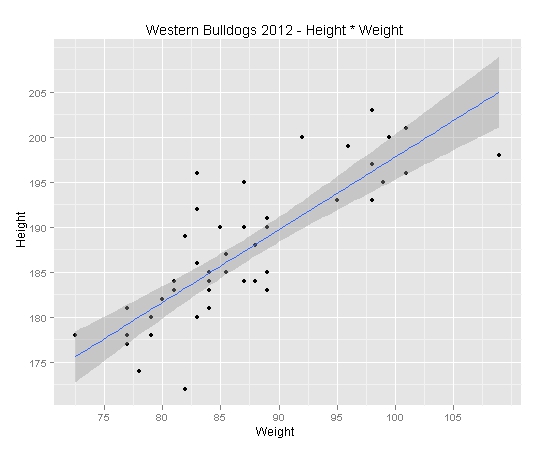
A plot of height versus weight shows a clear linear relationship:
 
 
From this relationship, we can find equations to predict height from weight, or vice versa:

          Height =  117.108 + 0.8078 * weight

          Weight = - 68.7018 + 0.8316 * height.


The R code to produce the chart above is :

library(ggplot2)

ggplot(wb, aes(WT,HT))+ geom_point() + scale_x_continuous("Weight") + scale_y_continuous("Height") + opts(title = "Western Bulldogs 2012 - Height * Weight") + geom_smooth(method = "lm")


This code produces a straight line smoother called "linear model".

The following code produces the same chart, with a different smoother:
 
 
ggplot(wb, aes(WT,HT))+ geom_point() + scale_x_continuous("Weight") + scale_y_continuous("Height") + opts(title = "Western Bulldogs 2012 - Height * Weight") + geom_smooth()

The geom_smooth() function in this case uses the default smoother "Loess" (for datasets up to n = 1,000 ). For the mathematically inclined, this smoother fits a polynomial line.

There is virtually no relationship between height and age:


ggplot(wb, aes(Age1Jan2012, HT))+ geom_point() + scale_x_continuous("Age") + scale_y_continuous("Height") + opts(title = "Western Bulldogs 2012 - Height * Age") + geom_smooth(method = "lm")

or

weight and age :


ggplot(wb, aes(Age1Jan2012, WT))+ geom_point() + scale_x_continuous("Age") + scale_y_continuous("Weight") + opts(title = "Western Bulldogs 2012 - Weight * Age") + geom_smooth(method = "lm")


And finally, here is the age distribution:


qplot(Age2, data = wb, geom = "histogram", binwidth = 1)+ scale_x_continuous("Age") + scale_y_continuous("Count") + opts(title = "Western Bulldogs 2012 - Number By Age")


Contested Posessions Plot Using ggplot2


Of interest to the R user (but unfortunately, not to the follower of footy ) is how to reproduce the Contested Possessions box-plot using ggplot2. Now ggplot2 is a well known package in R - ggplot2 is a powerful and flexible system for creating chart graphics - it's promise is extra flexibility and power than one gets with the charting functions in Base R.

ggplot2 has two options:

- qplot - this is the quick plotting function
- ggplot2 - this is the full plotting function, allowing almost unlimited customisation


My aim is to produce the box-plots initially using qplot, and then to recreate the plot in ggplot2.

This code produces the box-plot using qplot:

byafl <- with(afl, reorder(V2,V1))

qplot(byafl,V3, data = afl, geom = "boxplot", xlab = "Teams - Ladder Order", ylab = "Contested Possessions Per Game", main = "Contested Posessions 2011")


The equivalent code using ggplot2 is:

ggplot(afl, aes(byafl,V3))+ geom_boxplot() + scale_x_discrete("Teams - Ladder Order") + scale_y_continuous("Contested Possessions Per game") + opts(title = "Contested Possessions 2011")


Here is the plot using ggplo2 - is there any difference ?